
EXCLUSIVE CONTENT > AYRA STARR
Ayra Starr Wants Her Legacy to Be a Feeling
By Oumou Fofana • July 31, 2026
The Benin-born Nigerian star opens up about identity, protecting her roots, embracing every version of herself, and why true legacy has nothing to do with chart positions.
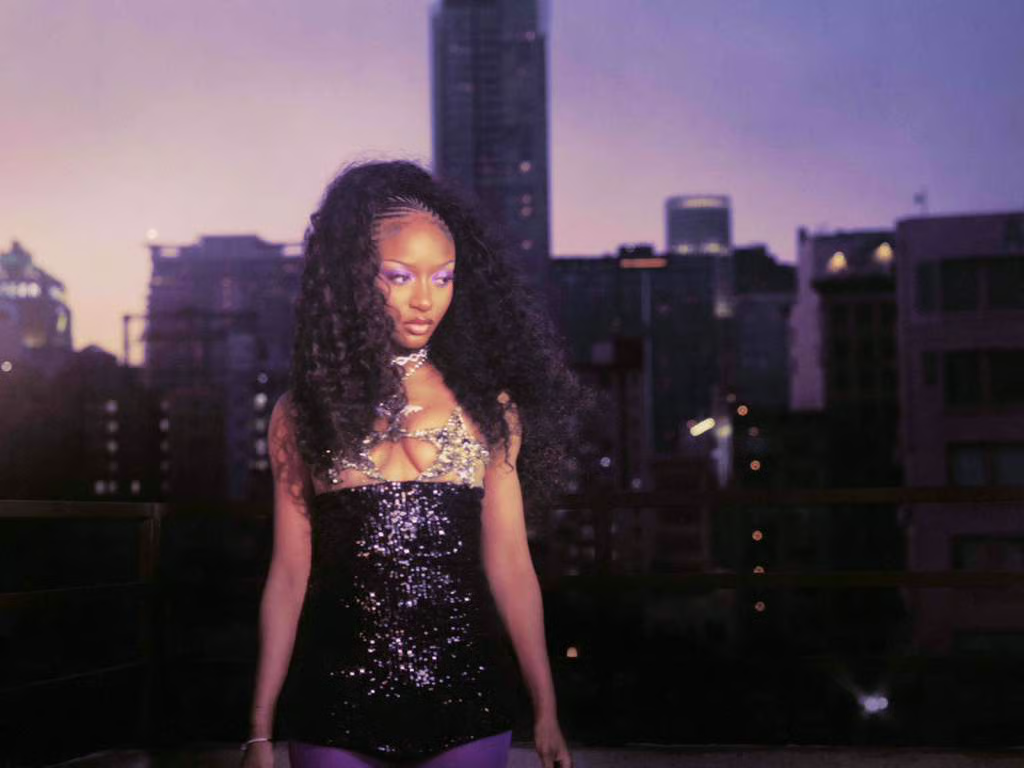
Photo Credit: Gina Gizelle
When Ayra Starr talks about home, she doesn't start with a country.
The Benin-born, Nigerian singer has spent the past few years moving between continents, festival stages and recording studios, helping push Afrobeats deeper into the global mainstream. But success hasn't changed the way she defines belonging. If anything, it's expanded it.
"Home is anywhere that grounds me," she tells BET. "It can be Lagos when I'm with my family. It can be when I'm in the studio, when I get to, just be away from everything else and just focus on what excites me the most, and that's music, or it can be when I'm in my apartment in New York. So home is anywhere that grounds me."
It's a fitting answer for an artist whose career has been built across borders. Ayra represents a generation of African artists redefining what it means to carry culture. She isn't choosing between identities or trying to fit into one audience. Instead, she's allowing every part of herself to exist at once. That mindset shapes the way she thinks about the teenager who first dreamed of making music.
"The young girl is very much still in me, and it's still my number one source of comfort," she says. "When I do something big, I just take a moment to just imagine that little girl just smiling at me. That's, like, one of my top five drives. Just knowing that I'm making younger me very proud."
That perspective also keeps the scale of her career from overshadowing why she started making music in the first place. For someone who has accumulated billions of streams, Grammy nominations, and international acclaim before turning 25, it's an unexpectedly personal measure of success.
There was one moment, though, when the weight of her influence became impossible to ignore. During a concert, she struggled to find her place geographically. Ayra remembers looking into the crowd and spotting a group of young girls singing every word back to her. "These girls are, maybe like, eight,” she recalls. “It was so cute 'cause they had their mini skirts, and they were in front, and they were just singing my music back to me word for word. And I was like, 'Why are you here? Who brought you here?' It just became real. There's never been anybody, like, a young Nigerian pop star or global superstar, and I knew why I was doing it."
The memory stayed with her long after the show ended. "At that moment, it became so real, and I was just like, 'Wow, I'm really doing the right thing, and I have a responsibility,'" she adds. "I just see girls that look exactly like me, have the same background, have the same dreams, look up to me, and I'm the one that they wanna be like, or I make them wanna dream bigger."
It's a responsibility she doesn't describe through statistics or chart positions. Instead, the “Rush” hitmaker talks about representation — about seeing herself reflected in the next generation and understanding that they now see themselves reflected in her.
“I see girls who look exactly like me, have the same background and the same dreams. I make them want to dream bigger.”
It's a responsibility she doesn't describe through statistics or chart positions. Instead, the “Rush” hitmaker talks about representation — about seeing herself reflected in the next generation and understanding that they now see themselves reflected in her.
As Afrobeats continues reaching audiences around the world, conversations often focus on protecting the genre. Ayra approaches it differently. "It's very important for me to protect who I am as an artist first, before any genres, to be honest," she says.
“It’s very important for me to protect who I am as an artist first, before any genres.”
For her, authenticity isn't separate from her roots. Afrobeats is me. I'm Afro. It's my sound because I'm Nigerian, and that's where I grew up," she explains. "No matter where I enter, what genres I try to do or try to experiment in, that would always be my background."
Rather than preserving the genre as something static, she sees it as something that naturally evolves because her identity evolves with it. "It's not an active thing that I want to keep. No. It's just who I am, and I allow that to show in different forms and whatever way it wants to."
That sense of self didn't appear overnight. Despite projecting self-assurance throughout her rise, the 24-year-old says she's experienced the same moments of uncertainty as anyone else. "My confidence is just like anybody, there's always days when I'm not the most confident," she says.
When those moments arrive, she turns inward instead of outward. "I'm surrounded by amazing people that help me recognize that, and God is my number one source of, you know, when it gets shaky, I just go back to the source and get back to how He's made me and called me, and who He's called me to be."
Growing up in public has only made that process more complicated. Since emerging as one of Nigeria's biggest young stars, much of her adulthood has unfolded online, where fans and critics often project their own expectations onto artists. "It's very tricky in a way because when you grow up in front of people, there will be a lot of projection on you based on what they think you should be doing and based on their idea of you," she says. "You have to be able to separate that and know what you want for yourself."
Ayra admits there were moments when she believed the internet's version of who she was. "It's something that comes with experience, to be honest," she continues. "It's not like I've always protected myself. It's like I've allowed the internet to tell me who I am, and I've believed it for very slight moments, and I come back to who I am and who I want to be and my dreams and my plans for myself."
"It's very hard," she adds. "But when you have a very solid foundation on who you are, it will be easy to go back, but it will happen no matter what."
The next chapter of Ayra Starr's story isn't about proving she belongs. It's about proving she doesn't have to fit inside anyone else's expectations. That mindset is at the heart of “Starrgirl”, her third studio album, which she describes as her most fearless body of work yet. While she's always experimented sonically, this time she says she stopped worrying about being placed in a box.
"Right now, my album is something that creatively is somewhere I've never gone because I was able to just experiment and try different things without the fear of being in a box or doing what is comfortable or what is expected of me," she emphasizes. “I've always been very experimental, but ‘Starrgirl’ is me doing it with all my heart and might and confidence, and this is what you get."
But she's already looking ahead. "Even after ‘Starrgirl', I'm just ready to try different things,” she states. “I want to sing more, I want to do more ballads. I want to probably drop a different type of sound.”
If you’re familiar with her biggest hits, you’d understand how the Mavin Records star's new project offers something deeper than another collection of singles. She hopes people discover the full scope of who she is as an artist: "I would say the version of me the listeners haven't seen before, it's just me allowing myself to exist in multitudes and showing that through the music.”
She also believes longtime fans have already seen glimpses of that side, but Starrgirl gives everyone else an opportunity to experience it too. "I feel like my fans know that part of me. But people, new fans or new people that would experience me through this album or only know my popular songs, this is a chance for them to experience that full galaxy and that guarding of sonics and different things I'm able to do and I love to do. So, it's just allowing myself to exist in multitudes, and I want them to see that."
That idea of "multitudes" became the foundation for the album's title. When asked what being a Starrgirl actually means, she doesn't describe fame or celebrity. Instead, she frames it as an ongoing conversation between where she comes from and where she's headed.
“Starrgirl is a bridge between tradition and self, knowing where I come from while allowing myself to create a new path.”
"Starrgirl for me is a bridge between tradition and self, and just knowing where I come from, but allowing myself to create a new path with that in mind," she explains. "Starrgirl is just allowing myself to be the multitude of talents and personalities I am. Starrgirl is a galaxy. She is not just one thing, she's a galaxy of stars and planets and everything in one."
That philosophy carries into the music itself. "The album is that body of work that shows these different parts confidently and very intricately," she says. "Because with Starrgirl, I'm able to do R&B, Afro R&B."
She points to songs inspired by the Disney pop music she grew up listening to, while explaining that her voice, cadence, and upbringing naturally tie everything together. "I have a song on the album called 'Misunderstood,' which is like really pop and the type of music I grew up listening to on Disney, and it's the type of music I've always wanted to make," she shares. "Me singing it with my cadence and my accent and my flow brings the Afro to it."
For the performer, genres aren't boundaries. They're simply different ways to tell the same story. That openness has also shaped what she's learned from working alongside artists from around the world. "The biggest thing I've learnt is you really just have to love this s**t, man," she says before apologizing for her language. "There's no way else to say it. You really have to f**king love this s**t, because that's the only way it's gonna make sense, and that's the only way it's gonna be worth it."
After collaborating across genres and generations, she's come to believe passion is the one quality every great artist shares. "I've watched people from different sides, different genres, different parts of the world, different generations and it's like the most important thing in this is that you love what you're doing and you're proud of your work and you're passionate, because that's the only thing that matters outside everything."
It's a simple answer, but one that explains why she continues to chase sounds she hasn't explored yet instead of repeating what already works.
Decades from now, Ayra hopes people won't remember her because of streaming numbers, chart positions or award wins. She hopes they'll remember how her music made them feel. "I hope they know and they feel. I don't even want them to know," she says. "I just want them to still feel the positivity and the high vibrations of the music I've put out. Even in 30 years, I want the music to touch them.I want it to inspire them and increase their confidence. I want them to feel seen by the music."
That may be the clearest definition of legacy for an artist like Ayra. Not simply making global music, but making music that helps someone, somewhere, feel at home.
“Even in 30 years, I want the music to touch them, inspire them, increase their confidence and make them feel seen.”
That may be the clearest definition of legacy for an artist like Ayra. Not simply making global music, but making music that helps someone, somewhere, feel at home.
MORE EXCLUSIVE CONTENT
BET IMMERSED - BLESSING JOLIE
Blessing Jolie is Learning Herself Through Every Song She Writes
Blessing Jolie discusses vulnerability, genre-bending, and the journey behind her debut album “20nothing.”